The Inquiry Commons
Photo Unsplash: Tim Van Cleef
The Inquiry Commons is a living library and it begins with questions rather than answers. Each collection opens a different window onto the larger inquiry, inviting us to examine assumptions we may rarely stop to question—about human dignity, institutional power, knowledge, healing, reality, relationship, systems, and the living world. Read together, these governing questions trace a widening path of inquiry: from how we treat one another to how we understand ourselves, the systems we create, and our place within the larger web of life.
What principles should govern how we treat one another?
Foundations: Dignity, Rights & Responsibilities
What happens when institutional power defines another human being?
Psychiatry & Mental Health
What happens when that power enters legal structures?
Law, Due Process & Accountability
Whose experience counts?
Witness, Testimony & Lived Experience
How do we know what we think we know?
Epistemology, Story & Ways of Knowing
What does it mean to heal and become whole?
Healing, Wholeness & Human Flourishing
What is the nature of the reality in which all of this occurs?
Consciousness, Relationship & the Real
How do human systems organize power, learn, fail, and change?
Organizations, Systems & Transformative Leadership
What is our place within the larger living world?
Ecology, Place & the Living World

Photo Unsplash: Johnny McClung
An Invitation to Explore
Every meaningful inquiry begins with a question.
Some readers arrive here because they are seeking to better understand mental health, psychiatric medications, civil commitment, or the history of psychiatry. Others come with questions about systems thinking, institutional power, healing, consciousness, leadership, ecology, or the restoration of right relationship. Still others simply sense that something about the modern world no longer feels fully human and are looking for a deeper way of understanding themselves, their communities, and the institutions that shape our lives.
Whatever question brings you here, I hope you will remain curious.
Among the questions explored throughout this Library are:
How do we know what we believe we know—and whose knowledge is granted authority?
How do stories shape identity, institutions, public understanding, and what comes to be accepted as real?
What happens when professional or institutional authority becomes more powerful than lived experience?
Why do institutions sometimes fail to recognize error, self-correct, or hold themselves accountable?
How do law, professional power, self-regulation, and institutional structures affect accountability and human rights?
What is epistemic injustice, and what happens when a person's knowledge of their own experience is discounted or displaced?
How have our understandings of mental health, illness, diagnosis, and treatment been constructed—and what alternative conversations have been marginalized or overlooked?
Is depression really caused by a chemical imbalance?
What does genuine healing require, and what allows human beings to move toward wholeness and flourishing?
What changes when we understand the body as a source of knowing rather than simply an object to be observed or treated?
How do relationship, community, place, nature, meaning, spirituality, and the Sacred shape human life and well-being?
What might our institutions look like if they were grounded more deeply in relationship, responsibility, dignity, and care?
And ultimately, what might become possible if we learned to see differently?
These are not simple questions, nor can they be adequately explored from within a single discipline. They invite us into conversations that cross the boundaries of psychiatry, law, organizational theory, systems thinking, consciousness studies, ecology, philosophy, ethics, spirituality, and the healing arts.
The Inquiry Commons was created to support that exploration—not by reproducing the dominant discourse already readily available within each field, but by gathering works that widen the frame, question established assumptions, recover neglected perspectives, and invite us to see from another vantage point.
Readers interested specifically in mental health, psychiatry, civil commitment, psychiatric medications, due process, and the historical development of the mental-health system will find those subjects explored more deeply throughout the Writings, as well as within the relevant collections here in the Commons.
The Practice of Inquiry
As you explore the materials gathered here, you may encounter ideas that affirm your understanding of the world. Others may challenge long-held assumptions, professional training, personal experiences, or deeply cherished beliefs. That is a natural part of inquiry.
When we encounter information that unsettles us, our first impulse is often to defend what we already know or to dismiss what feels unfamiliar. Yet these moments of discomfort can also become invitations—not necessarily to change our minds, but to become more curious about how we arrived at our current understanding in the first place. Notice what draws your attention. Notice what resonates. Notice what you immediately reject. Ask yourself gently: What within me is responding?
Sometimes our strongest reactions reveal not only something about the material before us, but also about the stories, experiences, assumptions, and relationships through which we have learned to make sense of the world.
As transdisciplinary scholar Alfonso Montuori reminds us:
"The role of the inquirer is not bracketed, but rather brought to the fore and the inquirer's assumptions, emotional responses, history and biases are explored and become part of the inquiry. Most importantly, there is a continuing effort to connect the inquiry not only to knowledge bases and theoretical frameworks, but also to lived experience and action."
— Alfonso Montuori (2010, p. 127)
Inquiry is not simply about gathering information. It is also about becoming more aware of the one who is doing the gathering.
As educator and epistemic scholar Barbara K. Hofer writes:
"In our most mundane encounters with new information and in our most sophisticated pursuits of knowledge, we are influenced by the beliefs we hold about knowledge and learning... As citizens, we are called on to judge competing claims... to weigh evidence, and to make decisions about issues of importance to ourselves and others. In each of these situations the adequacy of our epistemological theories will in some way determine what and how we make meaning of the information we encounter."
— Barbara K. Hofer (Hofer & Pintrich, 2002, p. 3)
Whether we are reading scientific research, legal opinions, historical accounts, or personal testimony, we are continually making judgments about credibility, authority, and meaning. Becoming aware of how we make those judgments is itself part of the inquiry.
As Montuori further observes:
"Inquiry is now not just directed 'outward' towards an external world, but it is rather seen as an ongoing process, a dialogue that engages knower and known, inquirer and inquiry ... becoming a virtuous circle using constant dialogue as an opportunity to see inquiry as an open, self-reflective, evolving system integrating body, emotions and mind."
— Alfonso Montuori (Nicolescu, 2008, p. xvi)
The deepest inquiry is never directed only toward the world around us. It also illuminates the ways we have learned to see that world.
About This Commons
No inquiry takes place alone.
The materials gathered here represent decades of reading, research, teaching, legislative advocacy, doctoral scholarship, lived experience, and transdisciplinary inquiry. They include primary documents, historical works, government reports, scholarship, books, testimony, and voices from across disciplines and generations.
The Inquiry Commons is not intended to reproduce the dominant literature of every field represented here. Those perspectives are already widely available through professional organizations, institutional publications, academic journals, textbooks, government agencies, and the prevailing discourse of their respective disciplines.
Instead, this Commons gathers work that helps open the inquiry.
Some of these sources challenge assumptions that have become so familiar they are rarely examined. Others recover histories or forms of knowledge that have been marginalized, forgotten, or overshadowed. Some cross disciplinary boundaries that ordinarily keep important conversations apart. Still others offer entirely different ways of understanding human beings, institutions, healing, consciousness, relationship, and the living world.
Their inclusion does not mean that every author represented here agrees with every other author—or that I endorse every position expressed within a particular work.
A commons is not a canon. It is a place of encounter.
The purpose is not to tell you what to think. It is to create a richer field within which thinking, questioning, discernment, and understanding can occur.
Wherever possible, I have included primary materials and significant source documents so that readers can encounter the evidence, history, and arguments for themselves rather than relying solely upon someone else's interpretation.
My hope is that this Commons encourages us to move beyond the boundaries of a single story, discipline, or authorized way of knowing—and to ask what becomes visible when we are willing to look again.
A Note to Readers
The Inquiry Commons is an educational resource intended to encourage thoughtful inquiry, careful discernment, and informed dialogue. The inclusion of a book, article, government report, or historical document does not imply agreement with every conclusion reached by its author. Nor should the collection be understood as an exhaustive bibliography of the fields represented here.
The Commons is deliberately curated and always evolving.
Its purpose is to make accessible sources, questions, histories, and ways of knowing that may enlarge an inquiry beyond the dominant frameworks through which a subject is commonly understood. Readers seeking conventional disciplinary positions will generally find them readily available through the professional, academic, governmental, and institutional sources in which those perspectives are already extensively represented.
The materials gathered here are offered in a different spirit: to encourage examination of assumptions, engagement with primary evidence, dialogue across disciplines, and continued attention to perspectives that may otherwise remain outside the prevailing conversation.
Intellectual openness does not require treating every claim as equally credible. It requires remaining willing to examine evidence, question one's assumptions, recognize the limits of one's own perspective, and allow new understanding to emerge when the evidence warrants it.
Nothing presented here should be understood as individual medical, psychiatric, psychological, or legal advice. Readers should consult appropriately qualified professionals regarding their own circumstances and medical or legal decisions.
In that spirit, welcome to The Inquiry Commons.
Affiliate Disclosure : Some links on this page are affiliate links. If you choose to purchase through them, this site may receive a small commission at no additional cost to you. These recommendations are included because they inform the intellectual foundations of this work, not because of affiliate participation. Thank you for your support in advance!

Photo Unsplash: Clay Banks
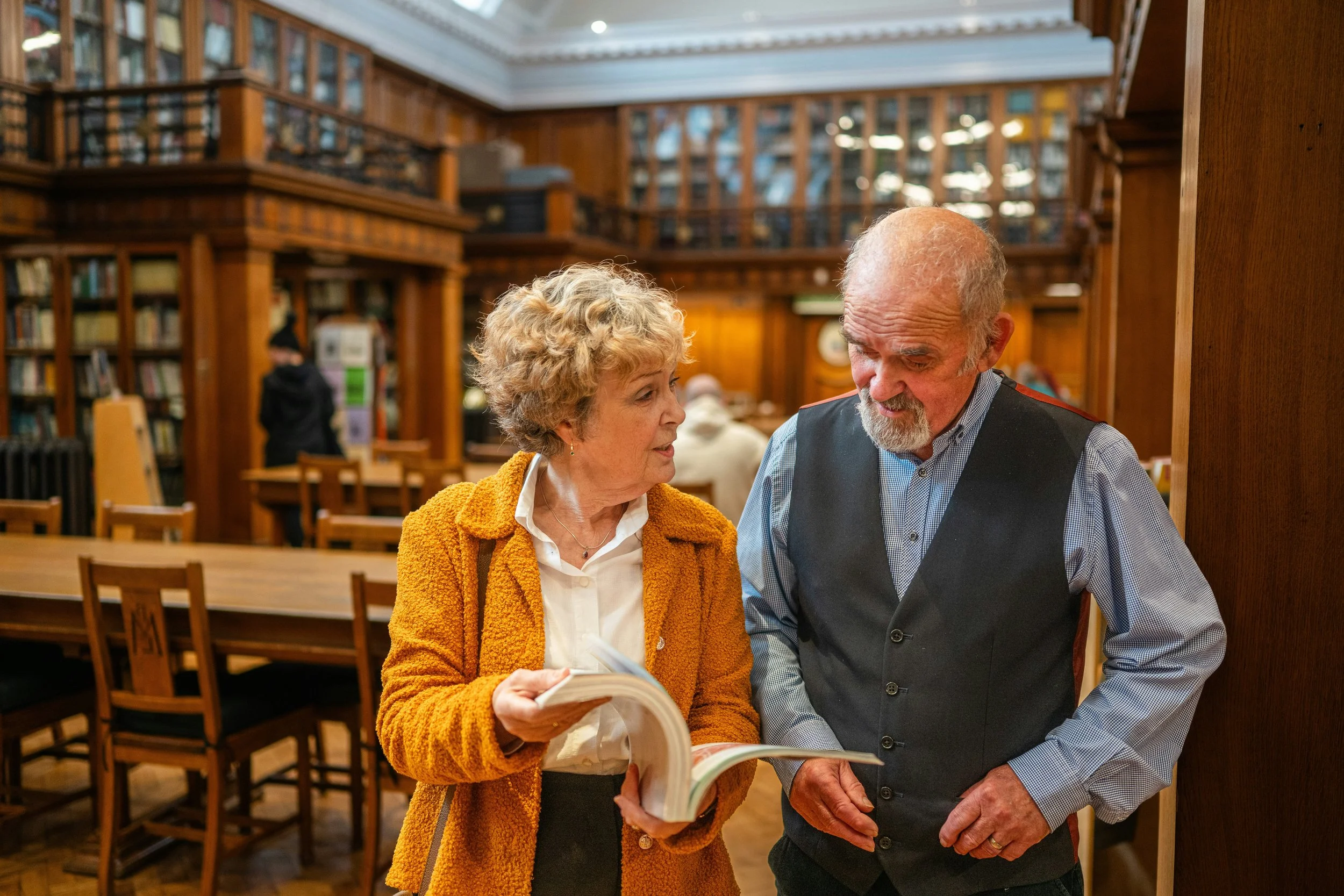
Photo Unsplash: Centre for Aging Better