Once, they said it was for our good. They spoke in the language of healing, draped in white, and we believed them. But the deeper we fall, the more we discover that the shimmer of madness was never ours alone.
Psychiatry made itself an authority over the mind, an interpreter of behavior, a gatekeeper between what society would call normal and what it would call disordered. But psychiatry did not acquire extraordinary power by itself. Government gave it power. Law gave psychiatric judgments consequences. Public institutions gave them reach. Courts gave them authority. Legislatures created mechanisms through which human beings could be confined, sterilized, experimented upon, medicated, and deprived of autonomy under systems claiming to act for health, welfare, safety, or the public good.
History leaves us some terrible examples.
When Experimentation Wore a White Coat
During the Cold War, the CIA created MKUltra, a sprawling secret program investigating methods of behavioral modification and interrogation. Among the physicians whose research received covert CIA support was prominent psychiatrist Dr. Donald Ewen Cameron, then one of the most powerful figures in international psychiatry.
At Montreal's Allan Memorial Institute, Cameron subjected patients to extraordinary procedures involving prolonged drug-induced sleep, repeated recorded messages he called psychic driving, powerful psychoactive drugs, and electroconvulsive treatments administered at intensities and frequencies far beyond conventional practice. Many of the people subjected to these experiments had entered seeking help for comparatively ordinary problems. Some emerged profoundly damaged.
Cameron did not run MKUltra; the CIA did. But his work became entangled with the program through covert funding, and the Montreal experiments remain one of the darkest intersections between psychiatric experimentation and government intelligence research.
Historian Jordan Torbay's 2023 examination of Cameron describes the Montreal experiments as a series of “brainwashing experiments” and traces Cameron's work from psychic driving into MKUltra. And that history reveals something perhaps more disturbing than the story of one psychiatrist: government power and psychiatric authority found use for one another.
The history is not merely being reconsidered by historians.
More than half a century after MKUltra began, the United States Congress is still asking questions.
On June 30, 2026, the House Committee on Oversight and Government Reform's Task Force on the Declassification of Federal Secrets convened a hearing titled “Mind Control and Accountability: Uncovering the Truth of the CIA's MKULTRA Project.” The hearing examined the history of MKUltra, the human experimentation conducted under the program, the destruction and continued classification of records, and the consequences of decades of government secrecy for public trust.
That Congress is still seeking greater transparency more than seventy years after MKUltra began tells us something important about institutional accountability: When records disappear, when secrecy surrounds government action, and when those harmed cannot see the full truth of what was done, history itself becomes harder to repair.
The white coat supplied legitimacy. The state supplied secrecy, money, and power. And human beings paid the price.
Sources:
Torbay, J. (2023). The work of Donald Ewen Cameron: From psychic driving to MK Ultra. History of Psychiatry, 34(3), 320–330. DOI: 10.1177/0957154X231163763.
McGill University Archives. Donald Ewen Cameron Fonds ( archival collection) and the Allan Memorial Institute records.
U.S. House of Representatives, Committee on Oversight and Government Reform. (2026, June 30). Mind Control and Accountability: Uncovering the Truth of the CIA's MKULTRA Project. 119th Congress, 2nd Session, Serial No. 119-68. U.S. Government Publishing Office. Official congressional hearing record — GovInfo. and House Oversight — MKUltra hearing
When the State Decided Who Should Reproduce
Across the twentieth century, more than 60,000 Americans were sterilized under compulsory sterilization laws adopted by more than 30 states. People classified as feebleminded, mentally ill, epileptic, dependent, promiscuous, or otherwise “unfit” could lose the ability to have children because professionals and government institutions determined that they should not reproduce.
Women bore a particularly heavy burden. Poor women. Disabled women. Institutionalized women. Women whose sexuality violated social expectations. Women whose lives were judged by people possessing the authority to decide what kind of person should be allowed to become a mother.
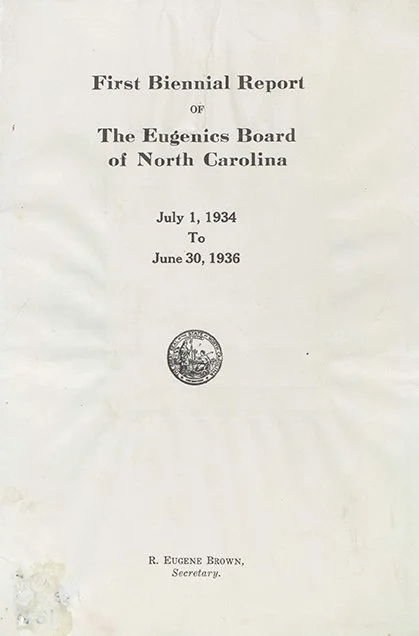
North Carolina's own historical accounting estimates that approximately 7,600 people were sterilized between 1929 and 1974 under the authority of its Eugenics Board program—through choice, force, or coercion. All 100 counties participated. The state acknowledges that North Carolina uniquely allowed social workers to petition for the sterilization of members of the general public.
California's program was larger still. California's own legislature has acknowledged that more than 20,000 Californians were sterilized between 1909 and 1979—more than one-third of the approximately 60,000 people sterilized nationwide under state eugenics laws during that era.
West Virginia enacted its own compulsory sterilization law in 1929, part of the much broader American eugenics movement documented by sociologist Lutz Kaelber's state-by-state research.
This was not simply one physician behaving badly in a back room. There were laws. Boards. Institutions. Professionals. Public money. Administrative procedures.
The machinery of government made the ideology actionable.
Sources:
North Carolina Department of Administration, Office of Justice for Sterilization Victims. History of the North Carolina Eugenics Board Program.
State of California. Legislative findings and historical records concerning California's eugenic sterilization program.
Kaelber, L. (2011). Eugenics: Compulsory Sterilization in 50 American States. University of Vermont.
When Medicine Joined the Machinery of Death
And then there is Nazi Germany.
Beginning in 1939, disabled children and adults—including people living in psychiatric and other institutions—were systematically murdered under what became known as the Nazi “euthanasia” program, or Aktion T4.
The word euthanasia was itself a deception. This was not mercy. It was systematic killing.
Physicians reviewed the records of institutionalized patients and participated in deciding who would live and who would die. Children were killed through lethal medication and starvation. Adults selected under Aktion T4 were transported to six killing centers, where gas chambers disguised as showers were used to kill them with carbon monoxide.
The United States Holocaust Memorial Museum estimates that approximately 250,000 people with disabilities were murdered between 1939 and 1945 through the Nazi “euthanasia” program and its various phases.
And the historical connection to what followed is chilling. The T4 program became a model and training ground for later mass murder. Personnel who had worked within T4 later served at the killing centers of Belzec, Sobibor, and Treblinka.
Medicine did not create Nazism. Psychiatry did not create the Holocaust. But physicians, psychiatrists, nurses, administrators, bureaucrats, and institutions became participants when professional authority joined a government that had decided some human lives were less worthy than others.
That history should disturb us profoundly. Because it demonstrates what can happen when the language of health and human improvement becomes joined to unchecked state power.
Sources
United States Holocaust Memorial Museum. (2026). Euthanasia Program and Aktion T4. Holocaust Encyclopedia.
United States Holocaust Memorial Museum. (2026). The Murder of People with Disabilities. Holocaust Encyclopedia.
United States Holocaust Memorial Museum. Final Solutions: Murderous Racial Hygiene, 1939–1945. Holocaust Encyclopedia.
Who Holds the Key?
This is the truth we must be willing to confront: Psychiatry has never acted in isolation. Its power has always existed within larger legal, political, economic, and cultural structures. Government decides who may be confined. Law determines when bodily autonomy may be overridden. Courts decide whose testimony carries authority. Professional institutions determine who is credentialed to diagnose. Insurance and government programs determine which treatments are funded. Pharmaceutical companies influence the marketplace in which those diagnoses and treatments circulate.
And somewhere inside all of that machinery is a human being. A person with a story, body, family, history, a way of knowing, and a soul.
The Kingdom of Control
Today the mechanisms look different. There are DSM codes and clinical language. Forms and assessments. Treatment plans, court petitions, insurance codes, and professional standards.
But the underlying question remains: How much authority should any profession or government possess to define another person's reality and override that person's autonomy?
Who decides what is sane? Who defines the edge between sacred sensitivity and disorder, between unusual experience and pathology, between a soul speaking through crisis and a mind declared diseased? Who gets to write the story? And what happens when the people possessing that authority are wrong?
We do not need to claim that every psychiatrist intends harm to confront this history. Individual kindness cannot answer a structural question about power. The question is larger: What happens when professional certainty is joined to the coercive power of the state?
History has already given us answers. Some of them are horrifying. That is why informed consent matters. Why bodily autonomy matters. Why due process matters. Why independent oversight matters. Why the right to question professional authority matters. And why no profession—medical, psychiatric, legal, scientific, religious, or otherwise—should ever become so certain of its own righteousness that it no longer hears the human being standing before it.
Still, the soul rises. Still, the heart remembers. Still, we dare to speak.
So we follow the white rabbit further—not to remain forever inside the darkness, but to understand what happened there. To remember what was taken. To recognize the machinery when it begins turning again.
And to reclaim what was never theirs to own.
Photo Credit: Max Tcvetkov-Unsplash
Image: First Biennial Report of the Eugenics Board of North Carolina, 1934–1936. Courtesy of Z. Smith Reynolds Library, Wake Forest University.